
The fastest way to catch a fake pay stub is the bank statement

A one-bedroom in San Francisco now rents for more than $4,000 a month, and the paperwork applicants submit to win one is getting harder to trust. Application fraud means using falsified documents or a borrowed identity to qualify, and The San Francisco Standard reported that cheap AI tools have made those fakes faster to produce and harder to catch.
The story draws on a survey from Checkr, a background-check company that polled 1,400 landlords across 14 cities. Eighty-five percent of San Francisco landlords said they worry about fraud in tenant applications. Of those 14 cities, San Francisco had the highest share concerned about fake or altered pay stubs, bank statements, or income documents.
What San Francisco landlords are reporting
One in three San Francisco landlords said they had discovered identity theft in their buildings, and another 17 percent suspected it but could not prove it before the tenant moved out. Seventy percent discovered or suspected application fraud that led to an eviction, and 28 percent put their losses at $5,000 or more. Nationally, 65 percent said an approved applicant had concealed a criminal record, an eviction history, or other disqualifying information, against 59 percent in San Francisco.
Victor Kabdebon, general manager of Checkr's tenant screening platform, said "These findings show that rental fraud is a two-sided problem, and application fraud may be more prevalent and harder to detect than many people realize."
The San Francisco Apartment Association said it has not seen an increase in member concern. Gideon Kramer, a multifamily owner who edits the newsletter for the Small Property Owners of San Francisco Institute, has not run into fraud in his own buildings, though as a graphic designer he knows how easy documents are to fake. "As a landlord, my motto has always been 'Trust but verify.'"
Why a pay stub is easy to fake, and what still gives it away
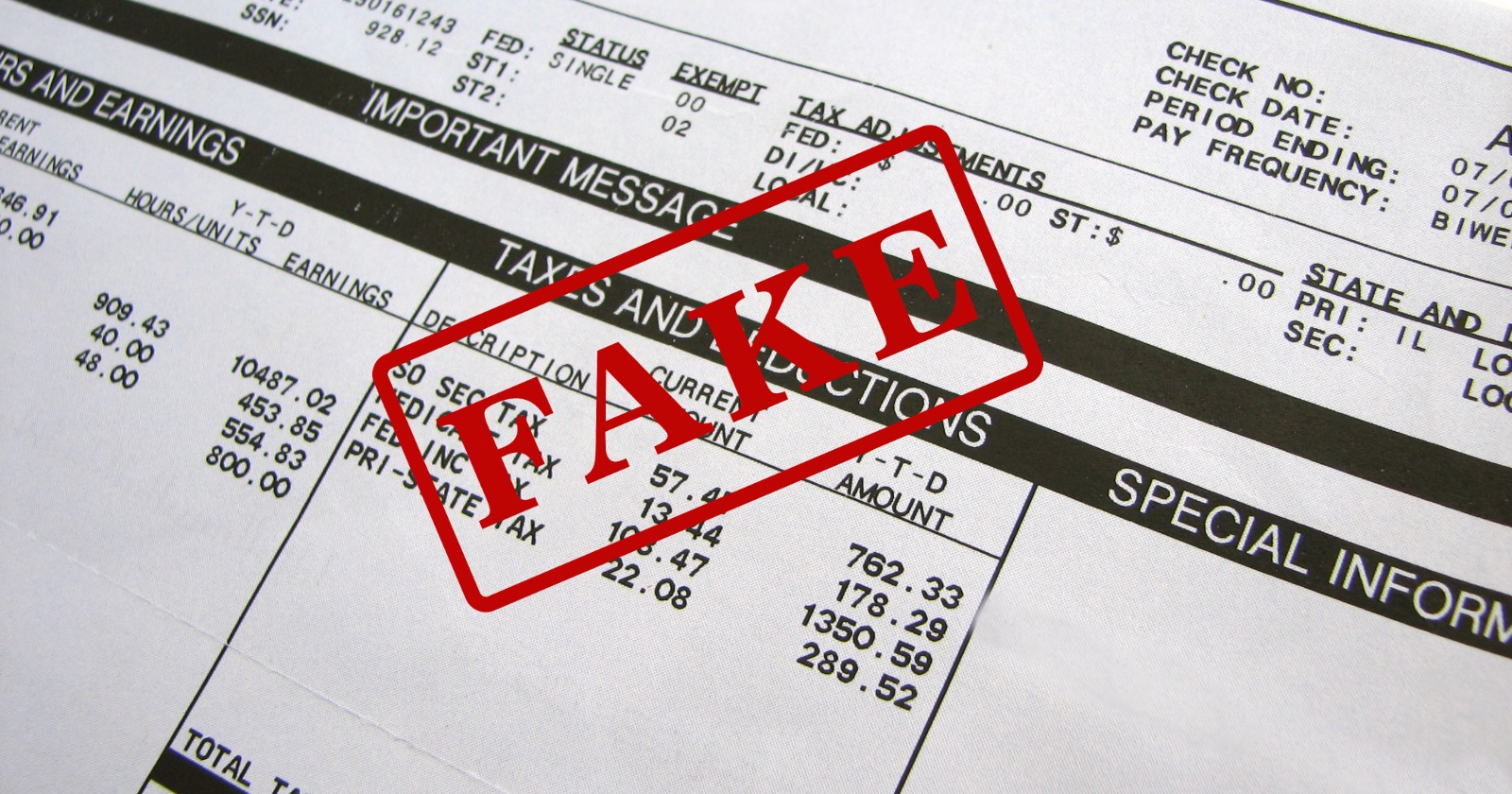
A pay stub has no signature, no seal, and no registry behind it. Anyone with a template can produce one that looks right at a glance. What fakes get wrong is the arithmetic.
Start with the internal math. Gross pay minus the listed deductions should equal net pay to the penny. Year-to-date totals should line up with the pay frequency and the hire date, so a March stub showing nine months of earnings is a problem. Withholding should look plausible for the stated income and filing status, not a flat 20 percent. Real net pay rarely lands on an even hundred.
Then look at the page. Fonts and alignment that shift partway down, a column off-baseline from its neighbor, or a logo at a different resolution all suggest editing. So does a generic employer identifier: no address, no phone, or a company name that returns nothing in a search.
Milan Jezdimirovic, a leasing agent at Compass, ran into this in 2024. He used an income verification app that flagged edited files, then required the applicants to produce legitimate proof of income instead. "AI did not create this, but it made fake documents faster to produce and harder to spot quickly," he said.
The bank statement is the check that matters
Ask for bank statements covering the same period as the pay stubs, then cross-check them. The net pay on each stub should appear as a deposit of the same amount on or about the same date, with the employer's name in the transaction description. A stub with no matching deposit is the single strongest tell you will find.
Deposits can be faked too. Income arriving as round transfers from an individual, or one large deposit days before the application, deserves questions, as does a statement showing a salary while the account carries no rent or utility payments.
Better still, skip the uploaded PDF. Payroll-linked and bank-linked verification services pull numbers from the source system instead of a file the applicant created. Use that where it exists, and treat uploads as the fallback.
Verify the employer and the prior landlord yourself
Never call the number printed on the pay stub or typed into the application. Look up the company yourself, call the main line or human resources number on its own website, and confirm employment, title, and start date. If the only way to reach an employer is a mobile number the applicant supplied, you have verified nothing.
Prior landlord references work the same way. Pull the owner of record for the applicant's previous address from county property records and contact that owner, rather than dialing the reference number on the form, which can route to a friend. If the person who answers does not own the building, keep pulling.
Jezdimirovic put the full list plainly: "We now have to verify everything more carefully: employer, deposits, prior landlord, credit, and ID."
Check the identity behind the paperwork
Identity fraud is worse than income fraud, because the person on your lease agreement may not exist, and a judgment against a borrowed name collects nothing.
Match a government-issued photo ID to the applicant in person or on a live video call, not from a submitted photo of a photo. Check that the name and date of birth stay consistent across the application, the ID, the stubs, and the statements. Then pull a credit report on that identity and read it for coherence: someone claiming six years at one employer should not have a credit file that opened last spring.
Look at the file, not only the numbers
A PDF exported straight from a payroll system behaves differently from one that passed through a design tool. Open the document properties and read the producer and creation fields. Text that sits in layers or will not copy cleanly suggests something was pasted over the original. An image-only scan of what should be a native PDF deserves a second look, as does a file created days after the pay date it shows. None of that proves fraud, so treat a strange file as a reason to run a direct-source check rather than grounds for denial.
Run every applicant through the same steps
Write your screening criteria and verification steps down, then apply them to every applicant in the same order. Inconsistent verification is how fraud gets through, and it is also how a landlord ends up answering a fair housing complaint, because an applicant asked for more proof than the next applicant has a story to tell.
Two sets of rules apply. If you pull a tenant screening report from a third party, the Fair Credit Reporting Act applies to you as the user of that report. The Federal Trade Commission tells landlords they may obtain consumer reports for housing purposes, and that an adverse action based on one requires written notice carrying the agency's name, address, and phone number, a statement that the agency did not make the decision, and notice of the applicant's right to dispute errors and request a free copy within 60 days. Score-based denials also require disclosing the score, its source, date, and range.
The second set is fair housing. The Department of Housing and Urban Development lists race, color, national origin, religion, sex, familial status, and disability as protected under the Fair Housing Act, and state or local law can add classes on top of those seven, as it does in California. Uniform criteria and written notes on every decision keep a fraud screen from turning into a discrimination claim.
If you find the fraud after move-in
Document first. Save the original submitted files, the verification results that contradict them, and a dated record of how you found the discrepancy. That is what an attorney will work from.
Then slow down. Fraud on an application is not an automatic fast path to eviction. San Francisco landlords in the Checkr survey were more likely than peers elsewhere to worry about running afoul of rent laws while removing a fraudulent tenant, given the city's strong tenant protections and high burden of proof. Talk to a local attorney before serving anything, and do not change locks, shut off utilities, or move belongings out, because a self-help eviction turns your problem into the tenant's claim.
Most of this work happens before signing. A residential lease signed by someone whose income and identity you never confirmed runs the full term, and 28 percent of the San Francisco landlords surveyed put that mistake at $5,000 or more.
Sources
Frequently Asked Questions
What is the fastest way to check whether a pay stub is real?
Compare it to a bank statement for the same period. The net pay on the stub should appear as a deposit of the same amount on about the same date, with the employer named in the transaction description.
Can I deny an applicant for submitting a forged document?
Yes, a falsified document is a legitimate, nondiscriminatory reason to deny. Apply the same rule to everyone, and if your decision rests on a third-party screening report, send the adverse action notice the Fair Credit Reporting Act requires.
How do I verify a prior landlord reference?
Look up the previous address in county property records and contact the owner of record instead of the number the applicant provided. A reference phone that reaches someone with no ownership connection to the building is a warning sign.
Along with his duties at YourBillofSale, Paul Oak covers residential real estate, landlord-tenant law, and rental documentation. With a background in property management and legal compliance, he breaks down the fine print that most renters and landlords skip over. His goal is simple: help people understand what they're signing before it becomes a problem.
View all posts →Create Your Lease Agreement
Need a lease agreement? Create one now for $7.99 - state-specific and professionally formatted.
Get Started - $7.99